
Introduction
When starting their investment journey, many beginners look for safe and disciplined ways to grow their money.
Two popular options often considered are:
- Systematic Investment Plans (SIPs)
- Recurring Deposits (RDs)
Both involve investing a fixed amount regularly, but they work very differently.
This raises an important question:
“SIP vs RD: Which is better for beginners?”
The answer depends on factors such as risk tolerance, financial goals, investment horizon, and return expectations.
Understanding the differences between SIPs and RDs can help investors choose the option that best suits their needs.
What is a SIP?
A Systematic Investment Plan (SIP) allows investors to invest a fixed amount regularly into mutual funds.
Instead of investing a large sum at once, SIPs promote disciplined investing through monthly contributions.
SIPs are commonly used for:
- wealth creation,
- retirement planning,
- children’s education,
- and long-term financial goals.
Returns from SIP investments depend on market performance.
You can use our SIP Calculator to estimate potential long-term investment growth.
What is a Recurring Deposit (RD)?
A Recurring Deposit (RD) is a savings product offered by banks and financial institutions.
In an RD:
- investors deposit a fixed amount every month,
- earn a predetermined interest rate,
- and receive maturity proceeds after the chosen tenure.
RDs are often preferred by individuals seeking predictable returns and capital stability.
SIP vs RD: Key Differences
| Feature | SIP | RD |
|---|---|---|
| Investment Type | Mutual Funds | Bank Deposit |
| Returns | Market-linked | Fixed Interest |
| Risk Level | Moderate to High | Low |
| Return Potential | Higher (not guaranteed) | Lower but predictable |
| Capital Protection | No guarantee | Generally protected by bank terms |
| Investment Horizon | Medium to Long Term | Short to Medium Term |
| Inflation Beating Potential | Higher | Limited |
| Flexibility | High | Moderate |
Which Option Offers Better Returns?
SIP
SIP returns are market-linked.
Over long periods, equity mutual funds have historically offered the potential for higher returns.
However:
- returns are not guaranteed,
- market fluctuations occur,
- and short-term volatility is possible.
RD
RDs provide fixed interest rates determined by the bank.
Investors know approximately how much they may receive at maturity.
The trade-off is that returns are usually lower compared to long-term equity investments.
Which Option is Safer?
RD: Higher Safety
For conservative investors:
- predictable returns,
- lower risk,
- and capital stability
make RDs attractive.
SIP: Market Risk Exists
SIPs invest in mutual funds, which are subject to market fluctuations.
Although short-term volatility exists, long-term investing may reduce the impact of temporary market movements.
Risk tolerance plays an important role when choosing between SIP and RD.
Can SIP Beat Inflation Better Than RD?
Inflation reduces purchasing power over time.
Since RD returns are fixed, they may sometimes struggle to outpace inflation consistently.
SIPs invested in growth-oriented mutual funds may offer better potential to generate inflation-adjusted returns over long investment horizons.
However, higher return potential comes with higher risk.
Who Should Choose SIP?
SIP may be suitable for investors who:
- have long-term financial goals,
- can tolerate market fluctuations,
- want wealth creation opportunities,
- and seek inflation-beating growth potential.
Examples:
- retirement planning,
- children’s education,
- financial independence.
Who Should Choose RD?
RD may be suitable for individuals who:
- prefer predictable returns,
- prioritize capital stability,
- have short-term financial goals,
- and have lower risk tolerance.
Examples:
- vacation savings,
- emergency fund goals,
- short-term planned expenses.
Can You Invest in Both SIP and RD?
Yes.
Many investors use both options depending on their financial goals.
For example:
SIP
Used for:
- long-term wealth creation,
- retirement,
- children’s education.
RD
Used for:
- short-term goals,
- planned purchases,
- emergency savings.
Combining both may help create a balanced financial strategy.
Common Mistakes to Avoid
Some beginners make mistakes such as:
- choosing SIP expecting guaranteed returns,
- investing in RD expecting high wealth creation,
- ignoring inflation,
- investing without clear goals,
- and selecting products based solely on popularity.
Understanding personal financial objectives is essential before making investment decisions.
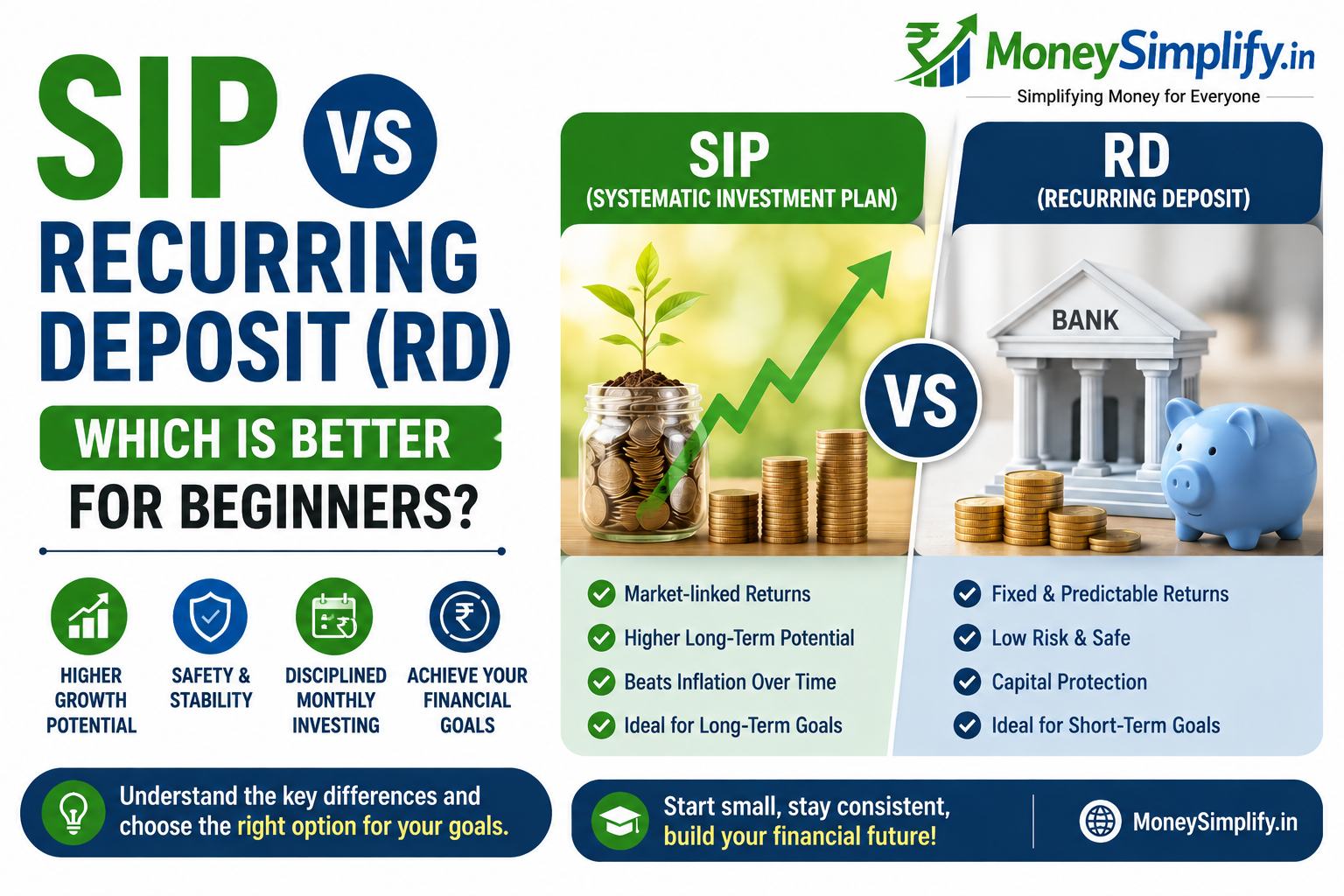
SIP vs RD: Which is Better for Beginners?
There is no universal winner.
SIP may be better if you:
✓ Have long-term goals
✓ Can handle market fluctuations
✓ Want higher growth potential
✓ Aim to beat inflation.
RD may be better if you:
✓ Prefer safety and stability
✓ Need predictable returns
✓ Have short-term goals
✓ Are uncomfortable with market risk.
The best choice depends on your financial situation and investment objectives.
Final Thoughts
Both SIPs and Recurring Deposits offer disciplined ways to save and invest regularly.
If your priority is long-term wealth creation and you are comfortable with market fluctuations, SIPs may offer better growth potential.
If you prioritize safety and predictable returns, RDs may be a suitable choice.
Many investors successfully use both products together to achieve different financial goals.
Before investing, consider:
- your risk tolerance,
- investment horizon,
- financial goals,
- and overall financial plan.
Choosing the right option depends on what works best for your personal circumstances.