
Introduction
When starting a Systematic Investment Plan (SIP), investors often focus on choosing the right mutual fund and investment amount.
However, another important decision is:
How often should you invest?
Most investors choose monthly SIPs, but some platforms also allow quarterly SIPs.
This raises an important question:
“Monthly SIP vs Quarterly SIP: Which option is better?”
The answer depends on factors such as income patterns, investment discipline, convenience, and personal preferences.
Let’s understand how both options work and which may be suitable for different types of investors.
What is a Monthly SIP?
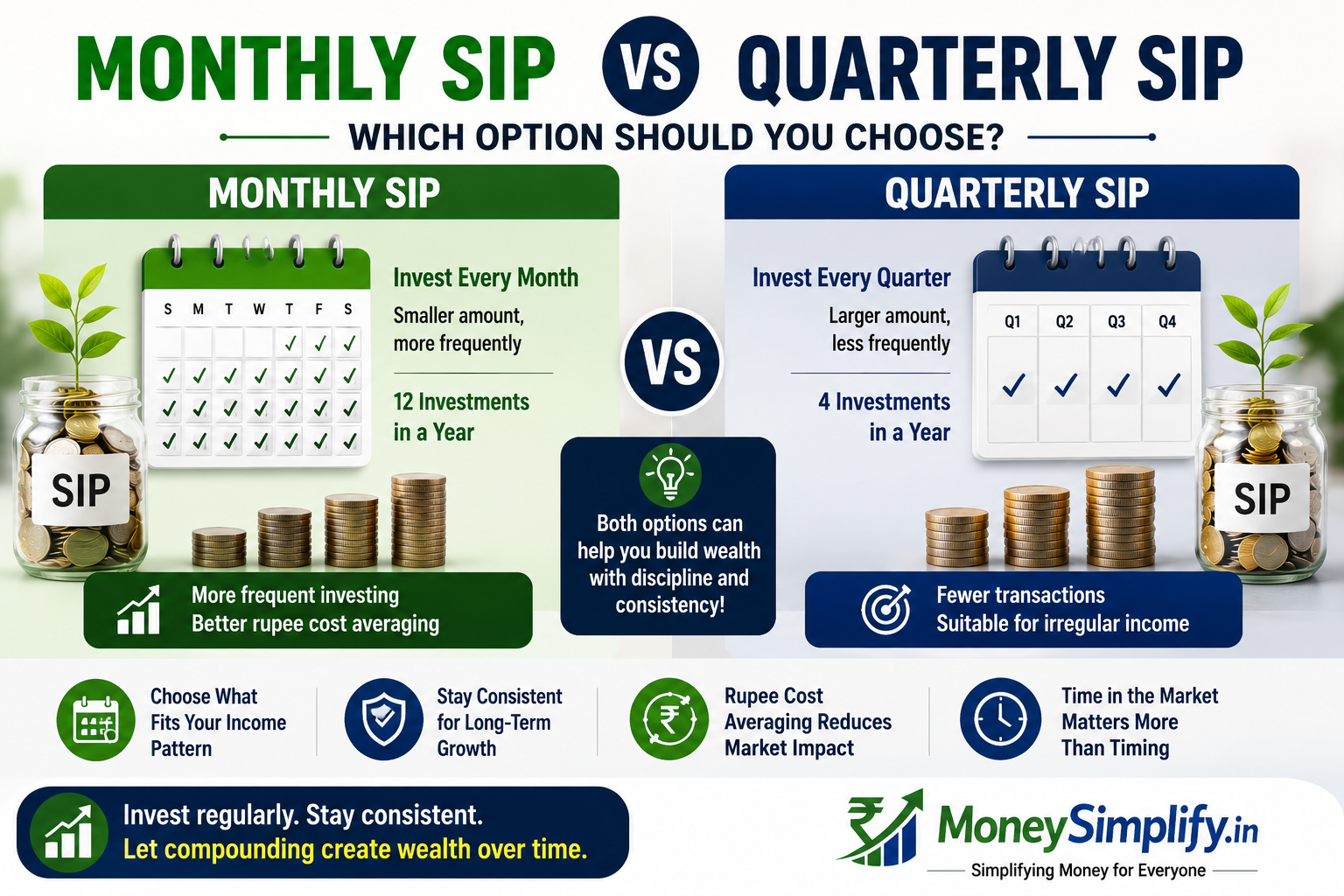
A Monthly SIP allows investors to contribute a fixed amount into a mutual fund every month.
For example:
- ₹5,000 invested on the 5th of every month.
Monthly SIPs are the most commonly used SIP frequency because many people receive salaries monthly.
This approach encourages consistent investing and aligns well with regular income cycles.
What is a Quarterly SIP?
A Quarterly SIP allows investors to invest a fixed amount once every three months.
For example:
- ₹15,000 invested every quarter.
Instead of twelve investments annually, investors make four investments each year.
Quarterly SIPs may be suitable for individuals whose income is not received monthly.
Monthly SIP vs Quarterly SIP: Key Differences
| Feature | Monthly SIP | Quarterly SIP |
|---|---|---|
| Investment Frequency | Every Month | Every 3 Months |
| Number of Installments | 12 per year | 4 per year |
| Alignment with Salary | Excellent | Moderate |
| Rupee Cost Averaging | More Frequent | Less Frequent |
| Investment Discipline | Strong | Moderate |
| Cash Flow Requirement | Lower Monthly Commitment | Higher Quarterly Commitment |
Understanding Rupee Cost Averaging
One major advantage of SIP investing is rupee cost averaging.
This means:
- buying more units when prices are lower,
- buying fewer units when prices are higher.
Since monthly SIPs invest more frequently, they may capture market fluctuations more effectively.
Quarterly SIPs provide fewer buying opportunities throughout the year.
However, over very long investment periods, the difference may not always be significant.
Which Option is Better for Salaried Employees?
For most salaried individuals, monthly SIPs are often more convenient.
Reasons include:
- salaries are usually received monthly,
- budgeting becomes easier,
- investments become part of a regular financial routine.
Monthly contributions may also reduce the temptation to spend money that was intended for investments.
Which Option is Better for Business Owners or Freelancers?
Some individuals do not receive fixed monthly income.
Examples include:
- business owners,
- freelancers,
- consultants,
- seasonal workers.
If income is irregular, quarterly SIPs may offer greater flexibility.
Investors can plan contributions based on cash flow availability.
Does SIP Frequency Affect Returns?
This is one of the most common questions.
In theory:
- monthly SIPs benefit from more frequent averaging,
- quarterly SIPs involve larger investments less frequently.
In practice, over long investment horizons, the difference in returns may not be substantial.
Factors such as:
- investment duration,
- fund selection,
- consistency,
often have a greater impact on outcomes than SIP frequency alone.
Which Option Helps Build Better Investment Discipline?
Monthly SIPs generally encourage stronger investing habits.
Since investments occur automatically every month:
- saving becomes routine,
- financial discipline improves,
- long-term consistency becomes easier.
Quarterly SIPs require larger commitments less frequently, which may increase the possibility of postponing investments.
Common Mistakes to Avoid
Some investors make mistakes such as:
- delaying investments while waiting for the “perfect” market timing,
- choosing quarterly SIPs despite monthly income availability,
- stopping SIPs during market volatility,
- focusing too much on frequency rather than consistency.
Long-term investing discipline is usually more important than choosing the perfect SIP interval.
Monthly SIP vs Quarterly SIP: Which Should You Choose?
Monthly SIP may be suitable if you:
✓ Receive monthly salary income
✓ Prefer smaller regular investments
✓ Want better investing discipline
✓ Prefer more frequent market participation
Quarterly SIP may be suitable if you:
✓ Have irregular income patterns
✓ Receive income seasonally
✓ Prefer fewer transactions
✓ Can comfortably manage larger periodic investments
Can You Change SIP Frequency Later?
In many cases, investors may modify their SIP preferences.
Depending on the investment platform, investors may:
- stop the existing SIP,
- create a new SIP with different frequency,
- adjust investment amounts as financial situations change.
Flexibility allows investors to adapt their investment strategies over time.
Final Thoughts
There is no universal winner between monthly SIP and quarterly SIP.
For most beginners and salaried individuals, monthly SIPs often provide better discipline, easier budgeting, and more frequent market participation.
However, quarterly SIPs may work well for individuals with irregular income patterns or unique cash flow situations.
Ultimately, successful investing depends more on:
- consistency,
- staying invested for the long term,
- and aligning investments with personal financial goals.
The best SIP frequency is the one you can comfortably maintain throughout your investment journey.
Use our SIP Calculator to estimate how monthly or quarterly SIP contributions may potentially grow over your investment journey.