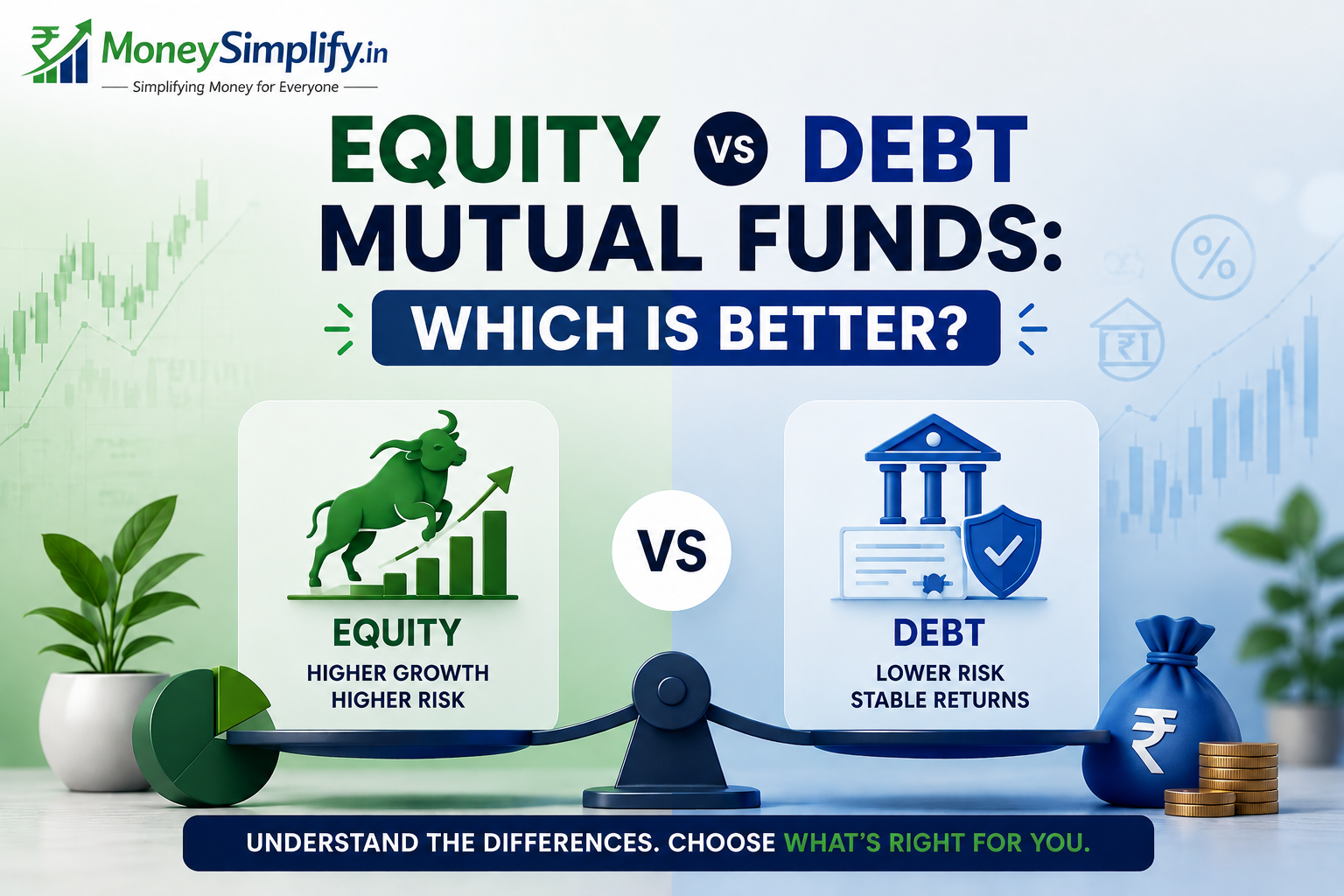
If you’ve started learning about mutual funds, you’ve probably come across two major categories: Equity Mutual Funds and Debt Mutual Funds.
Many beginners wonder:
“Which one is better – equity funds or debt funds?”
The honest answer is:
Neither is universally better. The right choice depends on your financial goals, investment horizon, and comfort with risk.
For example, someone investing for retirement 25 years away may have different needs than someone saving for a down payment on a house in the next two years.
In this guide, we’ll compare equity and debt mutual funds in simple language to help you understand their differences and decide which option may be suitable for your situation.
What Are Equity Mutual Funds?
Equity mutual funds primarily invest in stocks of companies listed on stock exchanges.
When you invest in an equity fund, you’re indirectly becoming a small owner of multiple companies through a professionally managed portfolio.
The primary objective of equity mutual funds is:
Long-term wealth creation through capital appreciation.
Example
Imagine Rahul is 28 years old and wants to build a retirement corpus over the next 30 years.
Since he has a long investment horizon and can tolerate short-term market fluctuations, equity mutual funds may align well with his long-term goals.
Characteristics of Equity Mutual Funds
- Primarily invest in company shares.
- Higher return potential over the long term.
- Subject to market volatility.
- Suitable for long-term investors.
- Can benefit from the power of compounding when investments are held for extended periods.
Potential Advantages of Equity Funds
1. Long-Term Wealth Creation
Historically, equities have offered the potential to generate higher returns compared to many traditional investment options over long periods.
2. Inflation-Beating Potential
Equity investments may help investors grow their wealth faster than inflation over time.
3. Professional Management
Fund managers research and select investments on behalf of investors.
Things to Keep in Mind
Equity mutual funds can experience significant short-term fluctuations.
It’s not uncommon to see market corrections or periods of underperformance.
This is why equity funds are generally more suitable for investors with:
- Longer investment horizons.
- Higher risk tolerance.
- Patience during market volatility.
What Are Debt Mutual Funds?
Debt mutual funds primarily invest in fixed-income securities, such as:
- Government securities
- Treasury bills
- Corporate bonds
- Money market instruments
Their primary objective is:
Providing relatively stable returns while preserving capital.
Example
Now consider Priya, who plans to use her money for a house down payment in the next two years.
Since preserving her capital is more important than pursuing aggressive growth, debt mutual funds may be a more appropriate choice.
Characteristics of Debt Mutual Funds
- Invest in fixed-income instruments.
- Generally lower volatility compared to equity funds.
- Suitable for short- to medium-term goals.
- Focus on stability rather than aggressive growth.
Potential Advantages of Debt Funds
1. Lower Volatility
Debt funds generally experience smaller price fluctuations compared to equity funds.
2. Better Capital Preservation
For investors with shorter investment horizons, protecting capital may be more important than maximizing returns.
3. Liquidity
Many debt funds offer relatively easy access to invested money.
Things to Keep in Mind
Although debt funds are often considered lower risk, they are not completely risk-free.
They can still be affected by:
- Interest rate changes.
- Credit risk.
- Economic conditions.
Therefore, investors should understand the specific risks associated with debt funds before investing.
Equity vs Debt Mutual Funds: Key Differences
| Feature | Equity Mutual Funds | Debt Mutual Funds |
|---|---|---|
| Primary Investment | Stocks of companies | Bonds and fixed-income securities |
| Objective | Long-term capital growth | Stability and regular income |
| Risk Level | Higher | Lower to moderate |
| Return Potential | Higher over the long term | Relatively moderate |
| Volatility | High | Lower |
| Investment Horizon | 5 years or more | Short- to medium-term |
| Suitable For | Growth-oriented investors | Conservative investors |
| Inflation Protection | Better potential | Limited potential |
| Capital Preservation | Lower priority | Higher priority |
Understanding Risk vs Return
One of the most important investing principles is:
Higher return potential often comes with higher risk.
Equity funds have the potential to generate higher returns over long periods, but they can experience short-term market declines.
Debt funds generally provide greater stability but may offer relatively lower return potential.
Neither approach is inherently right or wrong.
The key is finding the option that aligns with your goals and comfort level.
A Simple Analogy
Think of investing like planning a journey.
Equity Mutual Funds:
Choosing a faster route that may include bumps and unexpected turns but has the potential to help you reach your destination sooner.
Debt Mutual Funds:
Choosing a steadier route with fewer surprises, even if it may take longer to achieve substantial growth.
Both routes can be useful depending on where you’re going and how comfortable you are with uncertainty.
Which One Should Beginners Understand First?
Before deciding between equity and debt funds, beginners should ask themselves:
- What am I investing for?
- When will I need this money?
- How comfortable am I with market fluctuations?
- Can I stay invested during periods of volatility?
The answers to these questions often provide more clarity than trying to identify a universally “better” investment option.
In the next section, we’ll look at real-life scenarios, who should choose equity funds, who may benefit from debt funds, whether investing in both is possible, and answer some of the most common questions beginners have about these mutual fund categories.
Real-Life Scenarios: Equity vs Debt Mutual Funds
Sometimes, understanding investment options becomes easier when we look at real-life examples.
Scenario 1: Saving for Retirement
Rahul is 30 years old and plans to retire at 60.
Since his investment horizon is around 30 years, he has enough time to ride out market fluctuations and potentially benefit from long-term growth.
In this situation, equity mutual funds may be more suitable because they offer higher wealth creation potential over long periods.
Scenario 2: Buying a House in Two Years
Priya plans to make a down payment for a house within the next two years.
Since she cannot afford significant market volatility just before needing the money, debt mutual funds may be a better fit due to their relatively stable nature.
Scenario 3: A Balanced Approach
Amit wants long-term growth but also feels uncomfortable investing entirely in equities.
In such cases, investors often combine both equity and debt mutual funds to balance growth potential with stability.
This highlights an important point:
The choice isn’t always equity versus debt. Sometimes, a combination of both may align better with your goals.
Who Should Consider Equity Mutual Funds?
Equity mutual funds may be suitable if:
- Your investment horizon is 5 years or longer.
- You’re investing for long-term goals such as retirement or wealth creation.
- You understand that markets can fluctuate in the short term.
- You’re comfortable with higher risk in exchange for potentially higher returns.
Common Long-Term Goals
- Retirement planning
- Children’s higher education
- Building long-term wealth
- Financial independence goals
Who Should Consider Debt Mutual Funds?
Debt mutual funds may be suitable if:
- You have short- to medium-term financial goals.
- Capital preservation is a priority.
- You prefer relatively lower volatility.
- You have a conservative risk profile.
Common Short-Term Goals
- Emergency fund allocation
- House down payment
- Vacation planning
- Upcoming major expenses
Can You Invest in Both Equity and Debt Mutual Funds?
Yes.
In fact, many investors allocate money to both equity and debt mutual funds.
This approach is often called asset allocation.
For example:
Aggressive Investor
- Equity Funds: 80%
- Debt Funds: 20%
Moderate Investor
- Equity Funds: 60%
- Debt Funds: 40%
Conservative Investor
- Equity Funds: 30%
- Debt Funds: 70%
The appropriate allocation depends on factors such as:
- Financial goals
- Risk tolerance
- Investment horizon
- Personal comfort level
There is no universally correct allocation for everyone.
Is One Better Than the Other?
This is perhaps the most common question.
The answer is:
Neither equity mutual funds nor debt mutual funds are inherently better.
The better option depends entirely on your circumstances.
Equity Funds May Be Better If:
- You seek long-term wealth creation.
- You can tolerate market volatility.
- Your goals are several years away.
Debt Funds May Be Better If:
- Stability is important.
- You need money within a few years.
- You prefer lower-risk investments.
Rather than asking:
“Which is better?”
A more useful question may be:
“Which option is better suited to my financial goals?”
Frequently Asked Questions (FAQs)
Are equity mutual funds riskier than debt mutual funds?
Generally, yes.
Equity mutual funds tend to experience greater short-term fluctuations because they invest primarily in stocks. Debt mutual funds usually have lower volatility, although they still carry certain risks.
Can beginners invest in equity mutual funds?
Yes.
However, beginners should understand that equity investing requires patience and a long-term perspective to manage market volatility effectively.
Are debt mutual funds completely safe?
No investment is entirely risk-free.
Debt mutual funds may still be affected by interest rate changes and credit-related risks.
Which mutual fund category offers higher return potential?
Historically, equity mutual funds have provided higher long-term return potential compared to debt mutual funds. However, higher returns generally come with higher risk.
Can I switch from debt funds to equity funds later?
Yes.
Many investors adjust their portfolios over time as their financial goals and risk tolerance evolve.
Should I invest in only one type of mutual fund?
Not necessarily.
Many investors diversify by holding both equity and debt mutual funds as part of an overall financial plan.
Useful Tools to Plan Your Investments
If you’re planning to invest through SIPs, these calculators may help estimate potential outcomes:
SIP Calculator
If you’re investing regularly through SIPs, try our SIP Calculator to estimate how your monthly investments may grow over time.
Step-Up SIP Calculator
Expect your income to increase in the future? Use our Step-Up SIP Calculator to understand how gradually increasing your SIP amount each year may potentially accelerate wealth creation.
Crorepati SIP Calculator
Planning to build a ₹1 Crore corpus? Our Crorepati SIP Calculator can help estimate the monthly SIP amount needed to work toward this long-term financial milestone.
Final Thoughts
The debate between equity mutual funds and debt mutual funds doesn’t have a one-size-fits-all answer.
Both categories serve different purposes.
Equity funds focus on growth and long-term wealth creation, while debt funds emphasize stability and capital preservation.
The key is understanding your:
- Financial goals
- Investment timeline
- Risk tolerance
- Comfort with market fluctuations
Remember that successful investing isn’t about finding the “perfect” mutual fund category.
Instead, it’s about choosing investments that align with your unique financial journey and staying disciplined over the long term.
If you’re unsure where to begin, starting small, investing consistently, and continuing to educate yourself can be valuable first steps toward building financial confidence.
Disclaimer: Mutual fund investments are subject to market risks. Read all scheme-related documents carefully before investing. This article is intended for educational purposes only and should not be considered financial advice.