If you’ve started exploring mutual funds, you may have come across two common categories:
- Index Funds
- Actively Managed Funds
This often leads to an important question:
“Which is better: Index Funds or Actively Managed Funds?”
The answer isn’t straightforward.
Some investors prefer Index Funds because of their simplicity, lower costs, and passive investing approach.
Others choose Actively Managed Funds because they believe professional fund managers can potentially outperform the market.
The right choice depends on factors such as:
- Your investment philosophy
- Cost sensitivity
- Risk tolerance
- Confidence in active management
- Long-term financial goals
In this guide, we’ll compare Index Funds and Actively Managed Funds in simple language to help you understand how they work and which option may align better with your investment journey.
What Are Index Funds?
Index Funds are mutual funds that aim to replicate the performance of a specific market index.
Instead of trying to beat the market, these funds attempt to match the returns of the index they track.
Common examples include:
- Nifty 50 Index Funds
- Sensex Index Funds
- Nifty Next 50 Index Funds
Since Index Funds simply follow an existing index:
They are known as passively managed funds.
How Do Index Funds Work?
Suppose a Nifty 50 Index Fund tracks the Nifty 50 Index.
The fund invests in the same companies included in the index and generally maintains similar weightings.
If the Nifty 50 rises:
- The Index Fund aims to rise by a similar amount.
If the Nifty 50 falls:
- The Index Fund may also decline correspondingly.
The objective is:
To mirror market performance rather than outperform it.
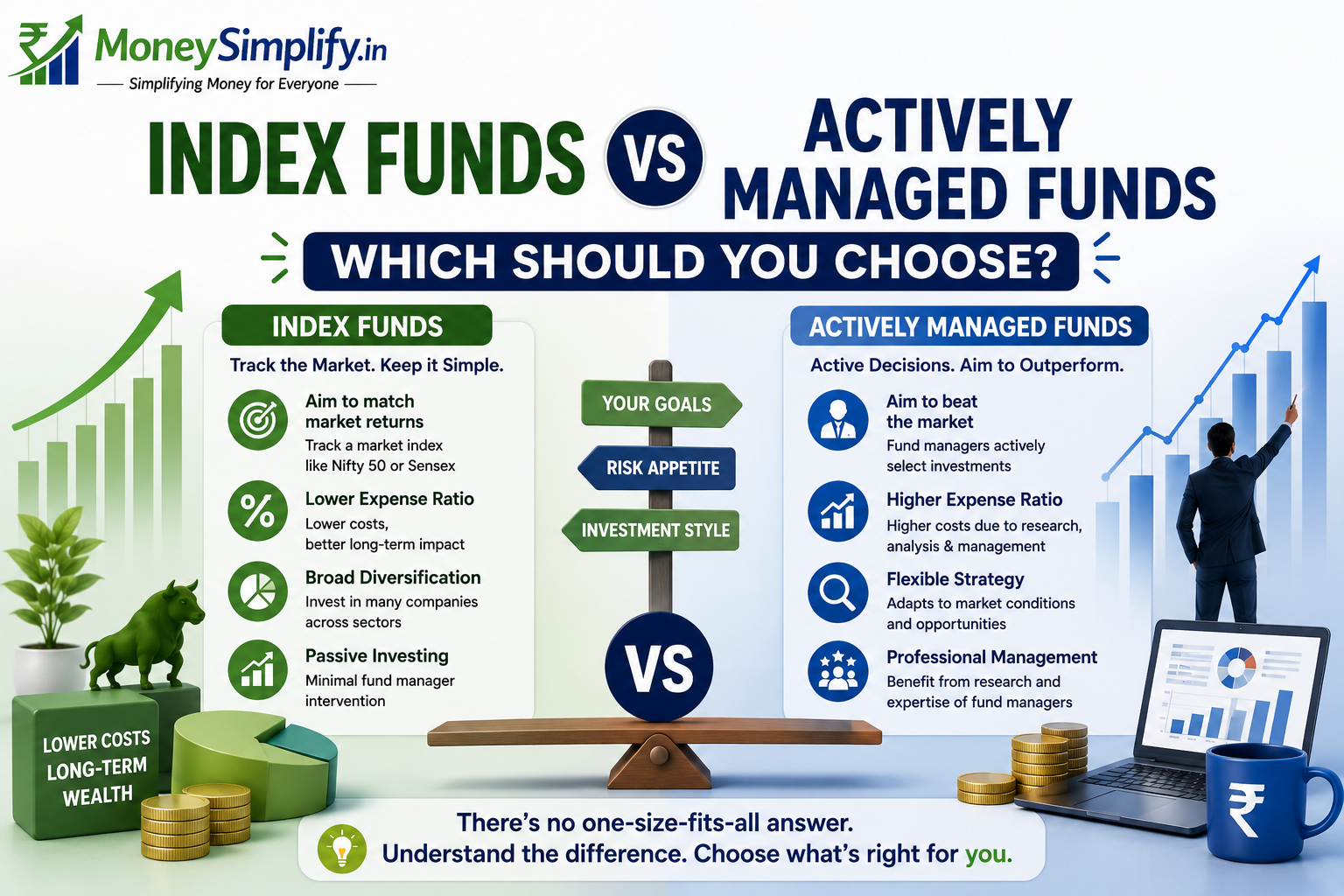
Characteristics of Index Funds
- Passive investment strategy.
- Lower expense ratios.
- Minimal fund manager intervention.
- Broad market diversification.
- Performance closely tracks the chosen index.
Potential Advantages of Index Funds
1. Lower Costs
Because Index Funds require less active research and stock selection, they usually have lower expense ratios.
Lower costs can improve long-term outcomes through the power of compounding.
2. Simplicity
Investors know exactly which index their money is tracking.
There are fewer surprises regarding investment style.
3. Broad Diversification
Index Funds often provide exposure to multiple companies across sectors.
This diversification can reduce company-specific risk.
4. Consistency with Market Returns
Rather than attempting to outperform the market, Index Funds focus on capturing overall market performance.
What Are Actively Managed Funds?
Actively Managed Funds are mutual funds where professional fund managers make investment decisions with the objective of:
Potentially outperforming the market benchmark.
Fund managers research companies, analyze market conditions, and actively decide:
- Which stocks to buy.
- Which stocks to sell.
- How much to allocate to each investment.
The goal is to generate returns that exceed the benchmark index.
How Do Actively Managed Funds Work?
Suppose an actively managed large-cap mutual fund uses the Nifty 50 as its benchmark.
Unlike an Index Fund:
- The fund manager may overweight certain sectors.
- Avoid companies they believe are overvalued.
- Increase exposure to businesses they expect to perform well.
The objective is:
To deliver returns that surpass the benchmark index after expenses.
Characteristics of Actively Managed Funds
- Professional fund management.
- Active stock selection.
- Higher expense ratios compared to Index Funds.
- Potential to outperform the market.
- Performance depends significantly on fund manager decisions.
Potential Advantages of Actively Managed Funds
1. Opportunity to Beat the Market
Experienced fund managers may identify investment opportunities that outperform benchmark indices.
However, outperformance is never guaranteed.
2. Professional Expertise
Investors benefit from:
- Market research.
- Company analysis.
- Portfolio monitoring.
This can be appealing to investors who prefer professional management.
3. Flexibility
Fund managers can adjust portfolios based on changing market conditions.
This flexibility may help manage risks or capture opportunities.
Index Funds vs Actively Managed Funds: Key Differences
| Feature | Index Funds | Actively Managed Funds |
|---|---|---|
| Investment Style | Passive | Active |
| Objective | Match market returns | Beat market returns |
| Fund Manager Role | Minimal | Significant |
| Expense Ratio | Lower | Higher |
| Stock Selection | Mirrors index | Fund manager decisions |
| Diversification | Broad index exposure | Depends on fund strategy |
| Performance Goal | Track benchmark | Outperform benchmark |
| Management Involvement | Low | High |
Expense Ratio: Why It Matters
One major difference between Index Funds and Actively Managed Funds is the expense ratio.
Since Index Funds follow a passive strategy:
- Research costs are lower.
- Portfolio turnover is generally lower.
- Management expenses tend to be lower.
Actively Managed Funds involve:
- Research teams.
- Fund managers.
- Frequent portfolio reviews.
- Active decision-making.
As a result:
Actively Managed Funds usually have higher expense ratios.
Even small differences in costs can influence long-term investment outcomes.
Can Actively Managed Funds Beat Index Funds?
This is one of the most debated topics in investing.
The reality is:
- Some actively managed funds outperform their benchmarks.
- Some match benchmark returns.
- Others underperform after accounting for expenses.
Past performance does not guarantee future results.
Therefore, investors should avoid assuming that active management automatically leads to better returns.
Similarly:
Index Funds do not guarantee superior performance simply because they have lower costs.
Both approaches have strengths and limitations.
A Simple Analogy
Imagine two students preparing for an exam.
Index Funds
The first student follows the standard textbook exactly.
The goal is to perform in line with the overall class average.
Actively Managed Funds
The second student hires tutors, uses additional resources, and follows a customized strategy aiming to score above average.
Sometimes this approach works exceptionally well.
Other times, despite additional effort and costs, results may be similar or even lower.
Neither approach is inherently superior.
The better choice depends on your preferences, beliefs, and investment goals.
In the next section, we’ll discuss who may prefer Index Funds, who may benefit from Actively Managed Funds, common myths, FAQs, and how to decide which approach aligns with your financial journey.
Who May Prefer Index Funds?
Index Funds may be suitable for investors who:
- Prefer a simple investment approach.
- Want broad market exposure.
- Believe that consistently matching market returns is sufficient for their goals.
- Want lower expense ratios.
- Prefer a passive investing strategy.
Example
Aman is a long-term investor who wants to build wealth for retirement over the next 25 years.
He doesn’t want to spend time analyzing fund managers or comparing actively managed funds.
For Aman, Index Funds may provide a simple and cost-effective solution.
Who May Prefer Actively Managed Funds?
Actively Managed Funds may be suitable for investors who:
- Believe skilled fund managers can potentially outperform the market.
- Are comfortable with slightly higher expenses.
- Want professional stock selection and portfolio management.
- Prefer a more hands-off approach while relying on expert decisions.
Example
Priya prefers having professional fund managers make investment decisions on her behalf.
She is comfortable paying slightly higher fees if there is potential for benchmark outperformance.
In her case, actively managed funds may align with her investment philosophy.
Can You Invest in Both?
Yes.
Many investors combine both Index Funds and Actively Managed Funds within their portfolios.
For example:
Conservative Approach
- Index Funds: 70%
- Actively Managed Funds: 30%
Balanced Approach
- Index Funds: 50%
- Actively Managed Funds: 50%
Active Preference Approach
- Index Funds: 30%
- Actively Managed Funds: 70%
The right allocation depends on:
- Financial goals
- Investment horizon
- Risk tolerance
- Confidence in active management
There is no universally correct allocation.
Common Myths About Index Funds and Actively Managed Funds
Myth 1: Index Funds Always Perform Better
Fact:
While lower costs can be advantageous, some actively managed funds have historically outperformed their benchmarks.
There are no guarantees.
Myth 2: Actively Managed Funds Always Beat the Market
Fact:
Many actively managed funds may underperform benchmark indices after expenses.
Fund performance varies over time.
Myth 3: Index Funds Are Risk-Free
Fact:
Index Funds are still subject to market risk.
If the market declines, Index Funds may also experience losses.
Myth 4: Higher Expense Ratios Guarantee Better Returns
Fact:
Paying higher fees does not automatically result in superior performance.
Investors should evaluate funds based on multiple factors, not just costs.
Frequently Asked Questions (FAQs)
What is the main difference between Index Funds and Actively Managed Funds?
Index Funds aim to replicate the performance of a market index, while Actively Managed Funds seek to outperform the benchmark through professional fund management.
Are Index Funds cheaper than Actively Managed Funds?
Generally, yes.
Index Funds typically have lower expense ratios because they follow a passive investment strategy.
Can Actively Managed Funds outperform Index Funds?
Yes, some actively managed funds may outperform their benchmarks.
However, outperformance is not guaranteed and can vary over time.
Are Index Funds suitable for beginners?
Many beginners appreciate Index Funds because of their simplicity, diversification, and lower costs.
However, suitability depends on individual financial goals and preferences.
Should I invest only in Index Funds?
Not necessarily.
Some investors prefer a combination of Index Funds and Actively Managed Funds to diversify their investment approach.
Which option is better for long-term investing?
Both approaches can play a role in long-term investing.
The appropriate choice depends on your investment philosophy, goals, and comfort level.
Helpful Tools for Mutual Fund Investors
If you’re investing through SIPs, these calculators may help estimate your future investment outcomes:
SIP Calculator
Use our SIP Calculator to estimate how your monthly investments may grow over time and support your long-term financial goals.
Step-Up SIP Calculator
Expect your income to increase over time? Try our Step-Up SIP Calculator to understand how gradually increasing your SIP amount annually may potentially accelerate wealth creation.
Crorepati SIP Calculator
Planning to build a ₹1 Crore corpus? Our Crorepati SIP Calculator can help estimate the monthly SIP amount needed to work toward this financial milestone.
Final Thoughts
The debate between Index Funds and Actively Managed Funds does not have a one-size-fits-all answer.
Index Funds offer:
- Simplicity
- Lower costs
- Broad market exposure
- Passive investing
Actively Managed Funds offer:
- Professional fund management
- Potential benchmark outperformance
- Active portfolio decisions
- Strategic flexibility
The most important question isn’t:
“Which option is universally better?”
Instead, ask:
“Which investment approach aligns better with my financial goals, beliefs, and comfort level?”
Successful investing often depends less on selecting the perfect fund type and more on:
- Investing consistently.
- Staying disciplined during market fluctuations.
- Keeping a long-term perspective.
- Continuing to improve your financial knowledge.
Remember:
Time in the market and disciplined investing habits often matter more than trying to find the “perfect” investment strategy.
Disclaimer: Mutual fund investments are subject to market risks. Read all scheme-related documents carefully before investing. This article is intended for educational purposes only and should not be considered financial advice.