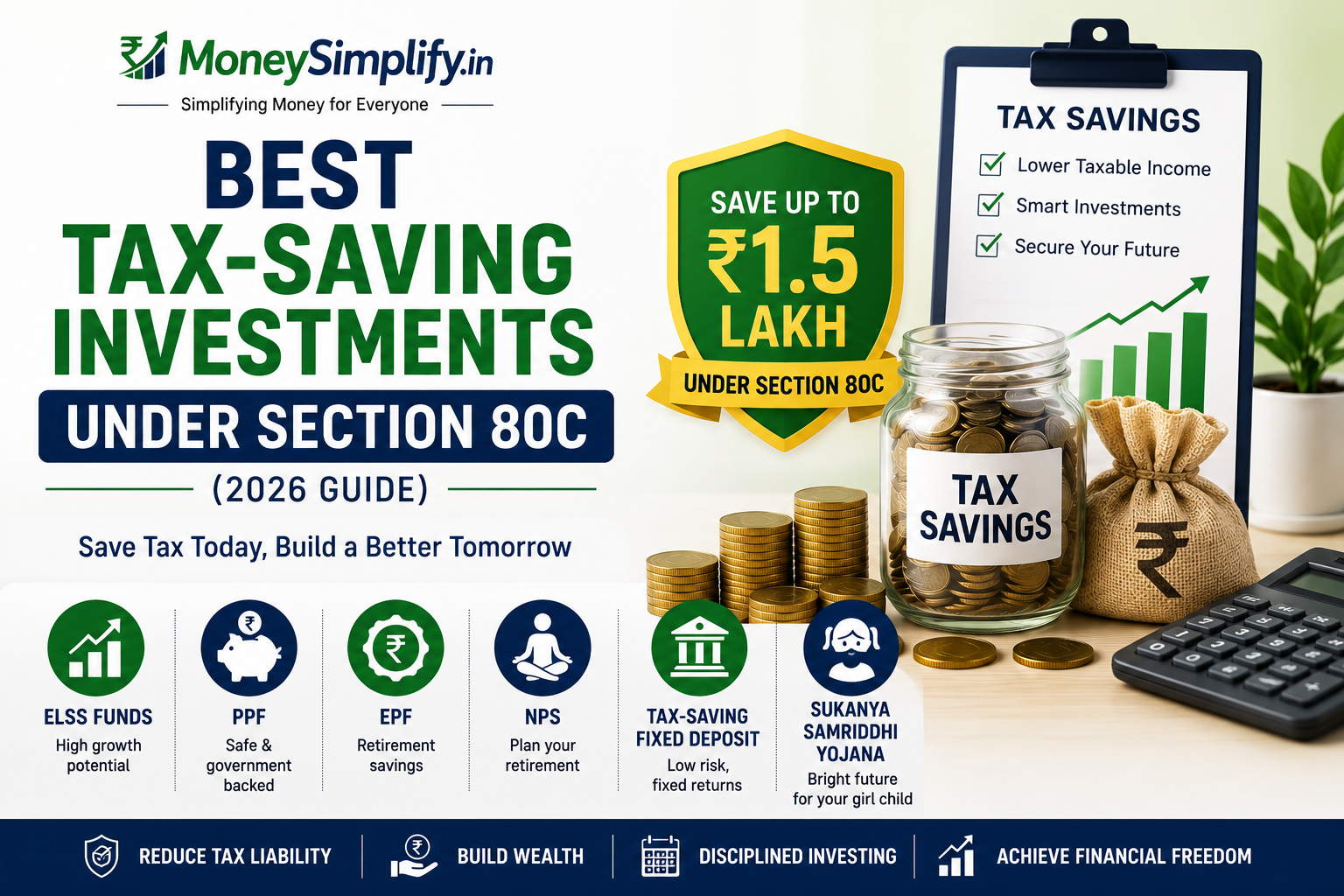
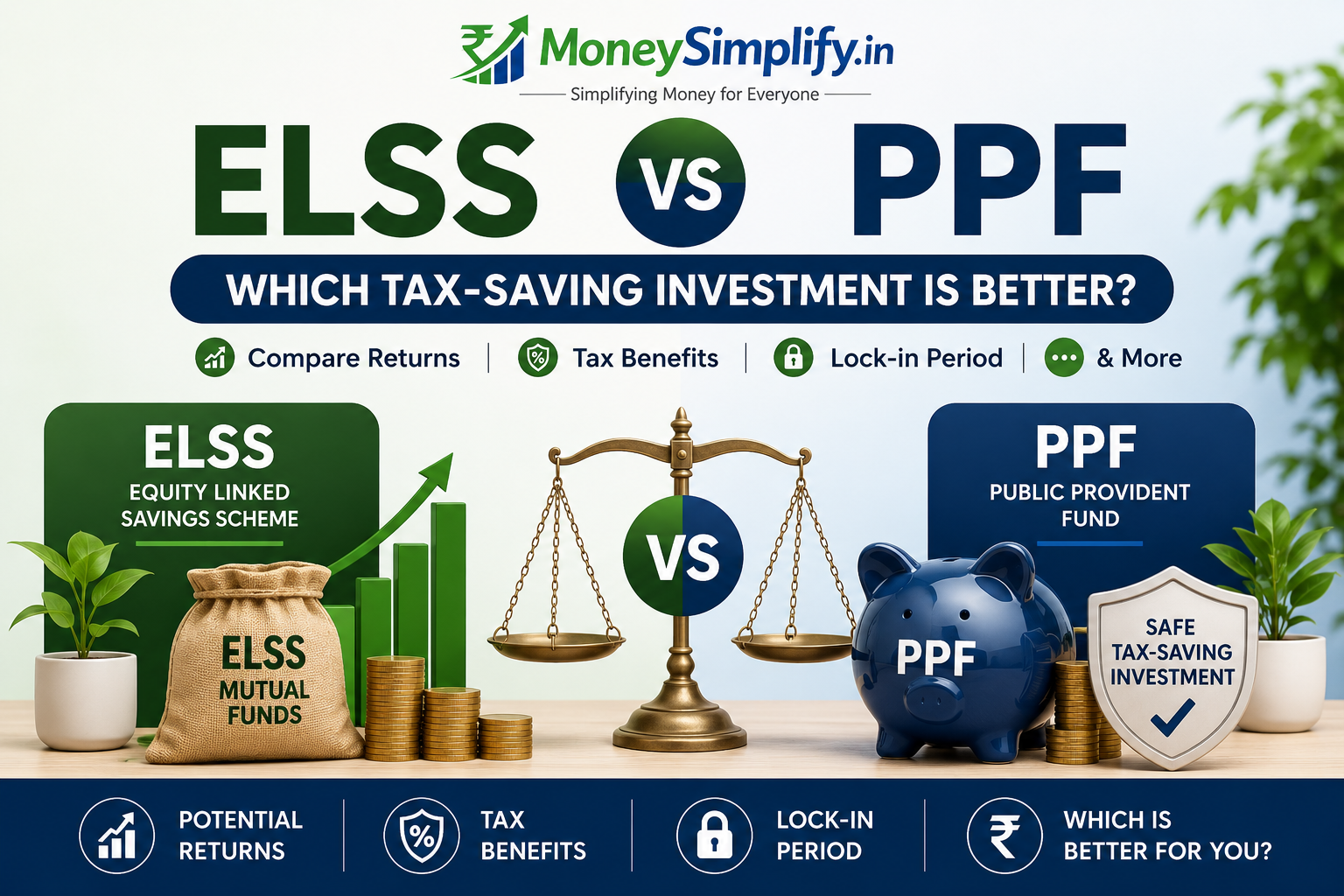
When it comes to saving taxes under Section 80C of the Income Tax Act, two of the most popular investment options among Indian investors are:
- Equity Linked Savings Scheme (ELSS)
- Public Provident Fund (PPF)
Both investments help you save taxes and build wealth over time. However, they differ significantly in terms of:
- Returns,
- Risk levels,
- Lock-in periods,
- Liquidity,
- Investment objectives.
This often leads investors to ask:
Should I invest in ELSS or PPF for tax saving?
The answer depends on your:
- Financial goals,
- Risk tolerance,
- Investment horizon,
- Preference for safety versus growth.
In this guide, we’ll compare ELSS vs PPF in detail to help you make an informed decision.
What Is ELSS?
Equity Linked Savings Scheme (ELSS) is a type of mutual fund that primarily invests in equity (stocks).
ELSS funds qualify for tax deductions under Section 80C, allowing investors to claim deductions of up to:
₹1.5 lakh per financial yearKey features of ELSS:
✓ Market-linked returns.
✓ Shortest lock-in period among Section 80C investments.
✓ Potential for long-term wealth creation.
✓ Professionally managed by fund managers.
Because ELSS invests predominantly in equities:
Returns are not guaranteed and depend on market performance.
What Is PPF?
Public Provident Fund (PPF) is a government-backed long-term savings scheme designed to encourage disciplined investing and retirement planning.
PPF also qualifies for tax deductions under Section 80C.
Key features of PPF:
✓ Government-backed investment.
✓ Fixed interest rate declared quarterly by the government.
✓ Low-risk investment option.
✓ Tax benefits under EEE (Exempt-Exempt-Exempt) status.
PPF is often preferred by conservative investors seeking capital protection.
ELSS vs PPF: Quick Comparison
| Feature | ELSS | PPF |
|---|---|---|
| Investment Type | Equity Mutual Fund | Government Savings Scheme |
| Risk Level | Moderate to High | Very Low |
| Returns | Market-linked | Government-declared interest |
| Tax Deduction | Up to ₹1.5 lakh under Section 80C | Up to ₹1.5 lakh under Section 80C |
| Lock-in Period | 3 Years | 15 Years |
| Liquidity | Higher | Lower |
| Wealth Creation Potential | High | Moderate |
| Capital Protection | No Guarantee | Government-backed |
| Suitable For | Growth-oriented investors | Conservative investors |
Tax Benefits: ELSS vs PPF
Both ELSS and PPF provide tax benefits under Section 80C.
Maximum deduction available:
₹1.5 lakh per financial yearHowever, the tax treatment differs slightly.
ELSS Taxation
Investment Stage
Eligible for deduction under Section 80C.
During Investment Period
No tax implications.
At Redemption
Long-Term Capital Gains (LTCG) tax rules apply.
Currently:
- Gains up to specified limits may enjoy tax exemptions under prevailing tax laws.
- Gains exceeding exemption thresholds may attract LTCG tax.
Investors should review current tax provisions before redemption.
PPF Taxation
PPF enjoys EEE status.
This means:
Exempt at Investment
Eligible for Section 80C deductions.
Exempt During Accumulation
Interest earned is tax-free.
Exempt at Withdrawal
Maturity proceeds are generally tax-free.
This makes PPF one of India’s most tax-efficient investment options.
Lock-In Period Comparison
Lock-in period is an important factor when selecting tax-saving investments.
ELSS Lock-In Period
ELSS has a lock-in period of:
3 YearsThis is the shortest lock-in period among all Section 80C investments.
After completion of the lock-in period:
- Units may be redeemed,
- Investors may continue staying invested for long-term wealth creation.
PPF Lock-In Period
PPF has a maturity period of:
15 YearsPartial withdrawals are permitted subject to applicable rules.
The long lock-in period makes PPF suitable for:
- Retirement planning,
- Long-term financial goals.
Returns: ELSS vs PPF
ELSS Returns
ELSS returns are:
Market-linked and not guaranteed.
Historically, equity investments have offered the potential for higher long-term returns.
However:
- Short-term volatility should be expected.
- Returns vary depending on market conditions.
PPF Returns
PPF offers:
Government-declared interest rates.
Advantages include:
✓ Stability.
✓ Predictability.
✓ Capital protection.
However:
- Return potential may be lower compared to equities over extended periods.
Risk Comparison
ELSS Risk Profile
Because ELSS invests in equities:
- Market fluctuations impact returns.
- Short-term losses are possible.
Suitable for investors who:
✓ Have a long investment horizon.
✓ Can tolerate market volatility.
✓ Seek higher growth potential.
PPF Risk Profile
PPF is backed by the Government of India.
Therefore:
✓ Capital safety is high.
✓ Returns are relatively stable.
Suitable for investors who:
✓ Prefer low-risk investments.
✓ Prioritize capital preservation.
✓ Seek predictable outcomes.
In the next section, we’ll compare suitability, liquidity, ideal investor profiles, common mistakes to avoid, FAQs, and help you decide whether ELSS or PPF is better for your financial goals.
Who Should Choose ELSS?
ELSS may be suitable for investors who:
✓ Are comfortable with market fluctuations.
✓ Have a long-term investment horizon.
✓ Seek potentially higher returns.
✓ Want tax-saving benefits with a shorter lock-in period.
✓ Already have an emergency fund and stable finances.
ELSS can be particularly attractive for young investors with several years remaining before major financial goals.
Remember:
A longer investment horizon generally helps investors manage short-term market volatility more effectively.
Who Should Choose PPF?
PPF may be suitable for investors who:
✓ Prefer capital safety.
✓ Have a conservative risk profile.
✓ Seek predictable returns.
✓ Are planning for long-term goals such as retirement.
✓ Value tax-efficient investments.
PPF is often preferred by investors prioritizing stability over aggressive growth.
ELSS vs PPF: Which Is Better?
The answer depends on your individual circumstances.
Choose ELSS If:
- You have an investment horizon of 5 years or more.
- You are comfortable with market risks.
- You seek potentially higher wealth creation opportunities.
- You prefer a shorter lock-in period.
- You already maintain sufficient emergency savings.
Choose PPF If:
- You prioritize capital protection.
- You prefer stable and predictable returns.
- You have a low risk tolerance.
- You are planning for long-term financial security.
- You value government-backed investments.
Can You Invest in Both ELSS and PPF?
Yes.
In fact:
Many investors combine ELSS and PPF to balance growth and stability.
For example:
Growth Component
ELSS can provide:
- Equity exposure,
- Long-term wealth creation potential.
Stability Component
PPF can provide:
- Capital preservation,
- Tax-efficient fixed-income exposure.
Combining both investments may help create a diversified tax-saving portfolio.
Common Mistakes to Avoid
When choosing between ELSS and PPF, avoid these common mistakes:
❌ Selecting investments solely for tax savings.
❌ Ignoring your risk tolerance.
❌ Investing in ELSS without understanding market volatility.
❌ Expecting guaranteed returns from ELSS.
❌ Overlooking the long lock-in period of PPF.
❌ Frequently redeeming investments due to short-term market movements.
Tax-saving investments should align with your broader financial goals.
Frequently Asked Questions (FAQs)
Is ELSS better than PPF?
Neither investment is universally better.
ELSS may suit growth-oriented investors.
PPF may suit conservative investors seeking stability.
The right choice depends on individual financial objectives.
Which investment has a shorter lock-in period?
ELSS has a lock-in period of:
3 yearsPPF has a maturity period of:
15 yearsTherefore:
ELSS offers significantly greater liquidity.
Is PPF completely risk-free?
PPF is backed by the Government of India and is generally considered a low-risk investment.
However, all investments should be evaluated within the context of individual financial goals.
Can ELSS provide higher returns than PPF?
Historically, equity investments have demonstrated the potential for higher long-term returns.
However:
- Returns are market-linked,
- Performance is not guaranteed.
Can I claim Section 80C deductions for both ELSS and PPF?
Yes.
Investments in both ELSS and PPF qualify under Section 80C.
However:
The combined deduction limit remains ₹1.5 lakh per financial year.
Which option is better for beginners?
There is no one-size-fits-all answer.
Beginners should consider:
- Financial goals,
- Risk appetite,
- Investment horizon,
- Need for liquidity.
Final Verdict: ELSS vs PPF
Choose ELSS if you:
✓ Want potentially higher long-term returns.
✓ Can tolerate market volatility.
✓ Prefer a shorter lock-in period.
✓ Have a long-term wealth creation objective.
Choose PPF if you:
✓ Prioritize capital safety.
✓ Prefer predictable returns.
✓ Are planning for retirement or long-term savings goals.
✓ Seek a government-backed investment option.
For many investors:
A combination of ELSS and PPF may provide an effective balance between growth potential and stability.
Ultimately:
The best tax-saving investment is the one that aligns with your financial goals, risk tolerance, and investment horizon.
Conclusion
Both ELSS and PPF offer valuable tax-saving benefits under Section 80C.
However, they serve different purposes.
ELSS focuses on:
- Wealth creation,
- Equity participation,
- Shorter lock-in periods.
PPF focuses on:
- Safety,
- Stability,
- Long-term financial discipline.
Understanding these differences can help you make informed investment decisions and build a stronger financial future.
Disclaimer: Tax laws, interest rates, and investment regulations may change over time. This article is intended for educational purposes only and should not be considered financial or tax advice. Please consult a qualified financial advisor or tax professional before making investment decisions.