
With thousands of mutual fund schemes available in India, choosing the right mutual fund can feel overwhelming for beginners.
Questions like these are common:
- Which mutual fund should I invest in?
- Should I choose equity or debt funds?
- Are direct plans better than regular plans?
- How important are returns and expense ratios?
The good news is:
Choosing a mutual fund doesn’t have to be complicated.
By understanding a few key factors, beginners can make informed investment decisions aligned with their financial goals and risk tolerance.
In this guide, we’ll discuss:
- How mutual funds work,
- Important factors to consider before investing,
- Common mistakes to avoid,
- And a simple step-by-step process to choose the right mutual fund.
Why Choosing the Right Mutual Fund Matters
Selecting the right mutual fund is important because:
- It affects your ability to achieve financial goals.
- Different funds carry different levels of risk.
- Costs and investment strategies vary across schemes.
- A well-chosen fund can support long-term wealth creation.
Remember:
There is no single “best” mutual fund for everyone. The best mutual fund is the one that matches your goals, investment horizon, and risk appetite.
Step 1: Identify Your Financial Goals
Before selecting any mutual fund, ask yourself:
Why am I investing?
Common financial goals include:
Emergency Fund
Investment Horizon:
Less than 3 yearsSuitable options may include lower-risk debt-oriented funds.
Buying a House
Investment Horizon:
5–10 yearsA combination of equity and debt funds may be considered.
Child’s Education
Investment Horizon:
10–15 yearsLonger investment horizons may allow for higher equity exposure.
Retirement Planning
Investment Horizon:
15–30 yearsEquity-oriented investments often play a significant role in long-term retirement planning.
Having clear goals helps narrow down mutual fund choices.
Step 2: Understand Your Risk Appetite
Risk appetite refers to:
Your ability and willingness to tolerate market fluctuations.
Generally, investors fall into three categories:
Conservative Investors
Prefer:
- Stability,
- Lower volatility,
- Capital preservation.
Suitable options often include:
- Debt Mutual Funds,
- Liquid Funds,
- Short Duration Funds.
Moderate Investors
Comfortable with:
- Some market fluctuations,
- Balanced growth opportunities.
Suitable options may include:
- Hybrid Mutual Funds,
- Balanced Advantage Funds.
Aggressive Investors
Can tolerate:
- Higher volatility,
- Short-term market declines,
- Long-term investment horizons.
Suitable options often include:
- Equity Mutual Funds,
- Index Funds,
- Large Cap, Mid Cap, and Small Cap Funds.
Remember:
Choosing investments beyond your risk tolerance can lead to panic decisions during market corrections.
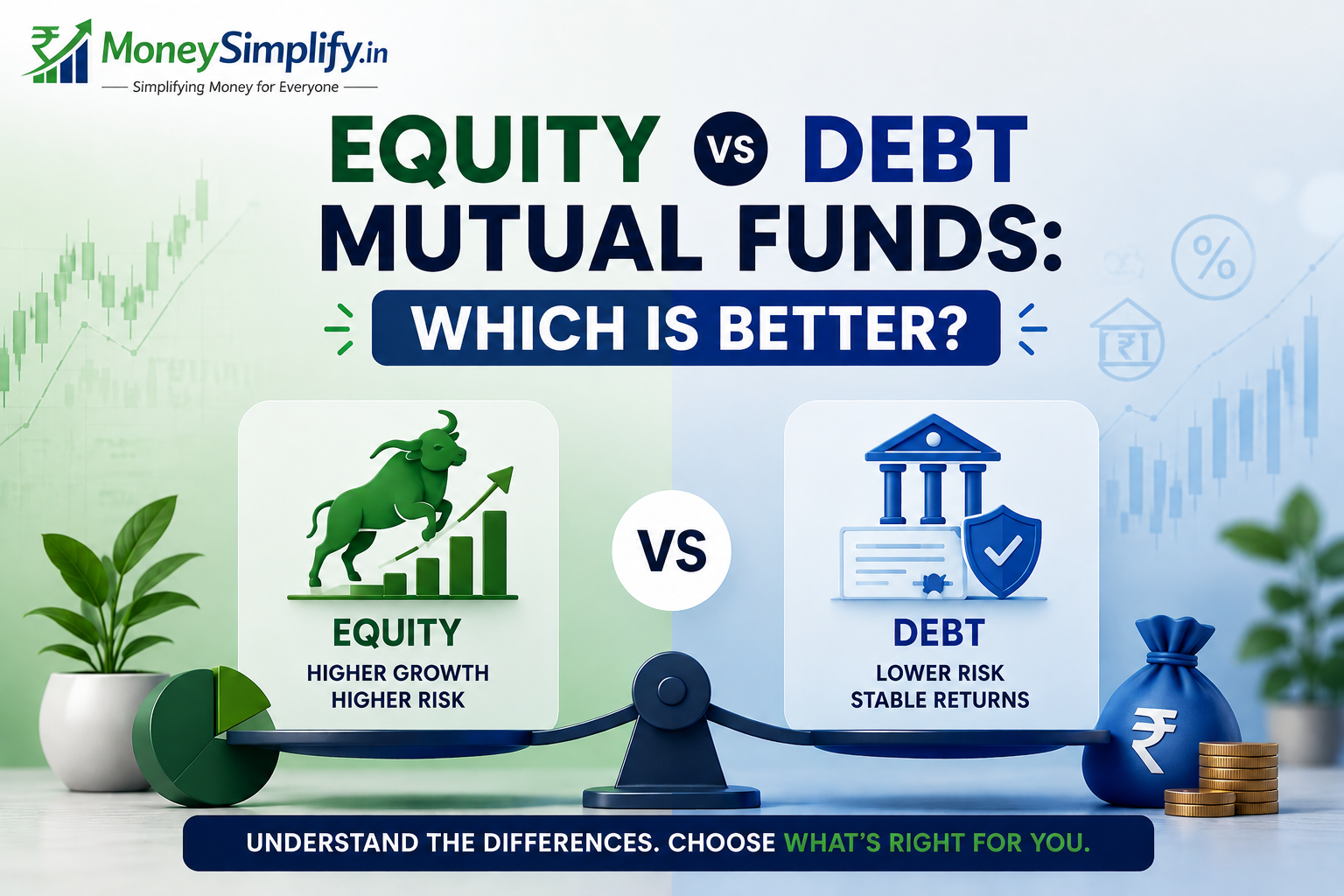
Step 3: Decide Between Equity, Debt, and Hybrid Funds
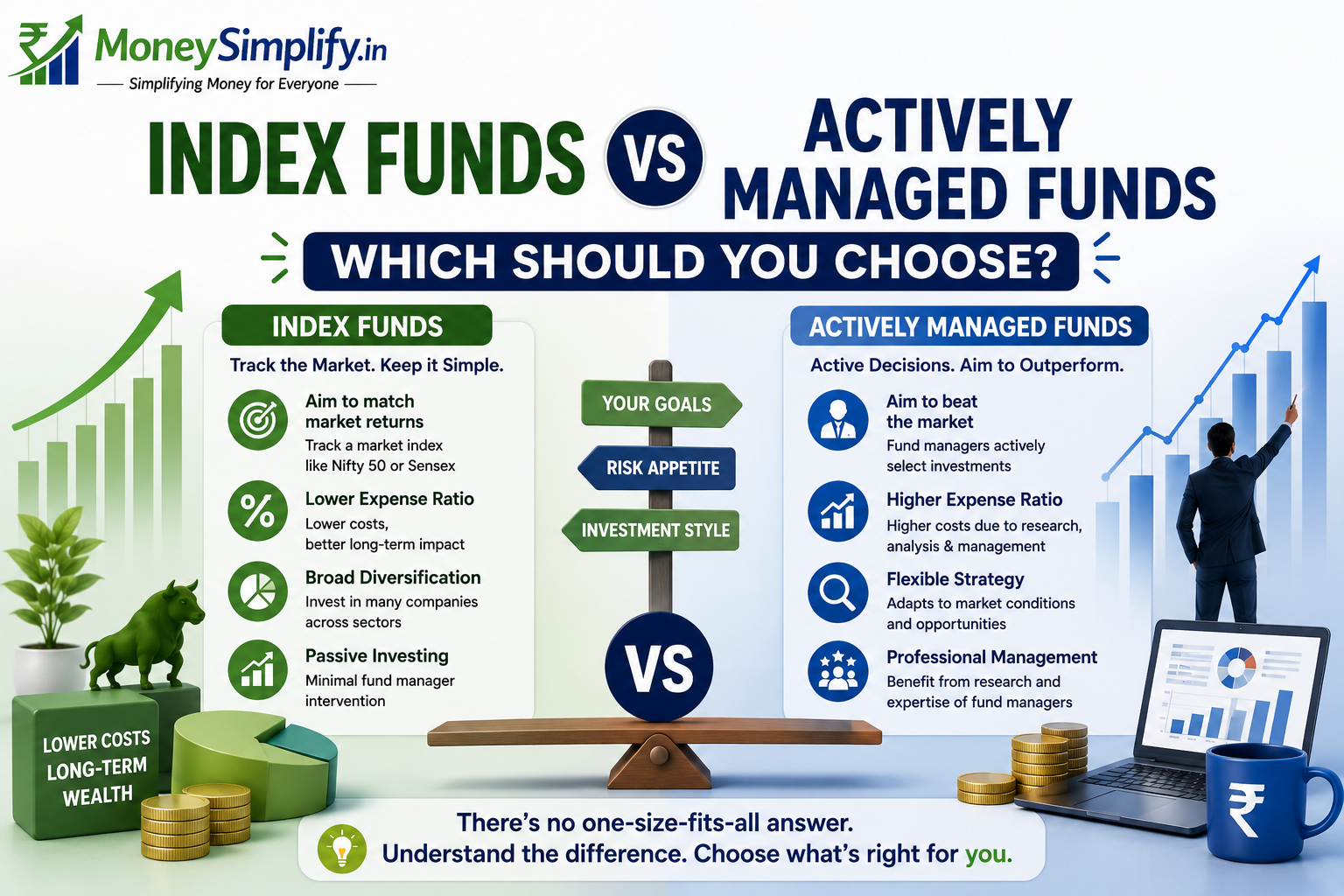
Different mutual funds serve different purposes.
Equity Mutual Funds
Primarily invest in stocks.
Potential advantages:
✓ Higher growth potential.
✓ Suitable for long-term goals.
Considerations:
- Higher volatility,
- Greater short-term fluctuations.
Suitable for:
Investment horizon of 5 years or more.Debt Mutual Funds
Primarily invest in fixed-income instruments.
Potential advantages:
✓ Lower volatility.
✓ Better suited for short-term goals.
Considerations:
- Lower return potential compared to equity funds.
Suitable for:
Investment horizon of less than 3–5 years.Hybrid Mutual Funds
Invest in both equity and debt instruments.
Potential advantages:
✓ Balanced risk and return profile.
✓ Diversification benefits.
Suitable for:
Investors seeking moderate risk exposure.Step 4: Choose Between Direct and Regular Plans
Mutual funds are available in two forms:
Direct Plans
Purchased directly from the Asset Management Company (AMC).
Advantages:
✓ Lower expense ratios.
✓ Potentially higher long-term returns due to lower costs.
Regular Plans
Purchased through distributors or advisors.
Advantages:
✓ Professional guidance.
Considerations:
- Higher expense ratios.
For investors comfortable conducting their own research:
Direct Plans may offer cost advantages over the long term.
Step 5: Evaluate the Fund’s Expense Ratio
Expense ratio refers to:
The annual fee charged by mutual funds for managing investments.
Lower expense ratios generally mean:
- More money remains invested,
- Better long-term compounding potential.
However:
Expense ratio should not be the only factor when selecting a mutual fund.
It should be evaluated alongside:
- Investment strategy,
- Fund consistency,
- Risk profile.
Step 6: Review the Fund’s Historical Performance
Past performance does not guarantee future returns.
However, reviewing historical consistency can provide useful insights.
Instead of focusing only on:
1-year returnsconsider evaluating:
- 3-year performance,
- 5-year performance,
- Performance across different market cycles.
Consistent performance may indicate disciplined fund management.
Step 7: Understand the Fund Category
Avoid comparing funds across different categories.
For example:
❌ Large Cap Fund vs Small Cap Fund.
❌ Debt Fund vs Equity Fund.
Instead:
Compare funds within the same category.
Examples:
✓ Large Cap vs Large Cap.
✓ Index Fund vs Index Fund.
✓ Hybrid Fund vs Hybrid Fund.
This allows for more meaningful evaluation.
Step 8: Check Exit Load and Investment Costs
Some mutual funds charge exit load if investments are redeemed before a specified period.
Review:
- Exit load percentage,
- Holding period requirements,
- Other investment-related charges.
Understanding these costs can help avoid unnecessary expenses.
Common Beginner Mistakes to Avoid
Many investors make avoidable mistakes when selecting mutual funds.
Avoid:
❌ Investing based solely on recent returns.
❌ Following investment trends without research.
❌ Ignoring expense ratios.
❌ Choosing funds inconsistent with risk tolerance.
❌ Frequently switching funds.
❌ Investing without clear financial goals.
Successful investing often depends on:
Consistency, patience, and disciplined decision-making.
In the next section, we’ll discuss a simple mutual fund selection framework, frequently asked questions, practical tips, and final recommendations for beginners.
A Simple 5-Step Mutual Fund Selection Checklist
If you’re still confused about choosing a mutual fund, use this simple framework:
Step 1: Define Your Financial Goal
Ask yourself:
- Why am I investing?
- What am I trying to achieve?
- How much money will I need?
Your investment goal should drive your fund selection.
Step 2: Determine Your Investment Horizon
Investment horizon refers to:
The amount of time you plan to stay invested.
General guidelines:
Less than 3 Years
Consider:
- Liquid Funds,
- Ultra Short Duration Funds,
- Short Duration Debt Funds.
3–5 Years
Consider:
- Hybrid Funds,
- Balanced Advantage Funds.
More than 5 Years
Consider:
- Equity Mutual Funds,
- Index Funds,
- Large Cap Funds,
- Flexi Cap Funds.
Longer investment horizons often allow investors to better manage short-term market volatility.
Step 3: Assess Your Risk Tolerance
Choose investments that align with your comfort level.
Ask yourself:
Can I remain invested if markets decline by 20–30% temporarily?
If not:
- Conservative investors may prefer debt-oriented solutions.
If yes:
- Equity-oriented funds may be suitable for long-term goals.
The right investment should help you sleep peacefully during market fluctuations.
Step 4: Compare Similar Funds
Before investing, compare funds within the same category.
Evaluate factors such as:
✓ Consistency of Performance
✓ Risk Profile
✓ Investment Objective
Avoid selecting funds based solely on recent returns.
Step 5: Stay Invested and Review Periodically
Once you select suitable funds:
Avoid making frequent changes based on short-term market movements.
Instead:
- Review your portfolio annually,
- Rebalance if financial goals change,
- Continue investing consistently.
Long-term discipline is often more important than selecting the “perfect” fund.
Frequently Asked Questions (FAQs)
Which mutual fund is best for beginners?
There is no universal answer.
The best mutual fund depends on:
- Financial goals,
- Investment horizon,
- Risk tolerance.
Many beginners start with:
- Index Funds,
- Large Cap Funds,
- Hybrid Funds.
Should beginners invest in direct or regular plans?
Investors comfortable doing their own research may prefer Direct Plans because of lower expense ratios.
Those seeking professional guidance may choose Regular Plans.
How many mutual funds should beginners invest in?
For most beginners:
2–4 well-selected mutual funds are often sufficient.
Owning too many funds can lead to unnecessary overlap and complexity.
Is past performance important?
Past performance can provide useful information about consistency.
However:
Past returns do not guarantee future performance.
Investment decisions should consider multiple factors.
Can I start with SIP investments?
Yes.
Systematic Investment Plans (SIPs) allow investors to:
- Invest regularly,
- Develop investment discipline,
- Benefit from rupee cost averaging.
SIPs are often considered suitable for beginners.
Should I choose funds with the highest returns?
Not necessarily.
Selecting funds solely based on recent returns can be risky.
It is generally better to focus on:
- Suitability,
- Consistency,
- Risk-adjusted decision-making.
Useful Calculators for Beginners
These tools can help you plan your investments more effectively.
SIP Calculator
Use our SIP Calculator to estimate how regular monthly investments may grow over time.
This can help you understand how consistency contributes to long-term wealth creation.
Step-Up SIP Calculator
Expect your income to increase over the years?
Our Step-Up SIP Calculator can help estimate how increasing SIP contributions annually may accelerate progress toward your financial goals.
Crorepati SIP Calculator
Planning to build a ₹1 Crore investment corpus?
Use our Crorepati SIP Calculator to estimate the monthly SIP amount required to work toward this milestone.
Final Thoughts
Choosing a mutual fund may initially seem complicated.
However, by focusing on a few important factors, beginners can simplify the process.
Remember to:
✓ Define your financial goals.
✓ Understand your risk appetite.
✓ Match investments to your time horizon.
✓ Compare funds within similar categories.
✓ Stay invested with discipline and patience.
Most importantly:
The best mutual fund is not necessarily the one with the highest returns. It is the one that helps you achieve your financial goals comfortably and consistently.
Successful investing is often less about finding the perfect fund and more about:
Starting early, investing regularly, and remaining committed to a long-term plan.
Disclaimer: Mutual fund investments are subject to market risks. Read all scheme-related documents carefully before investing. This article is intended for educational purposes only and should not be considered financial advice.