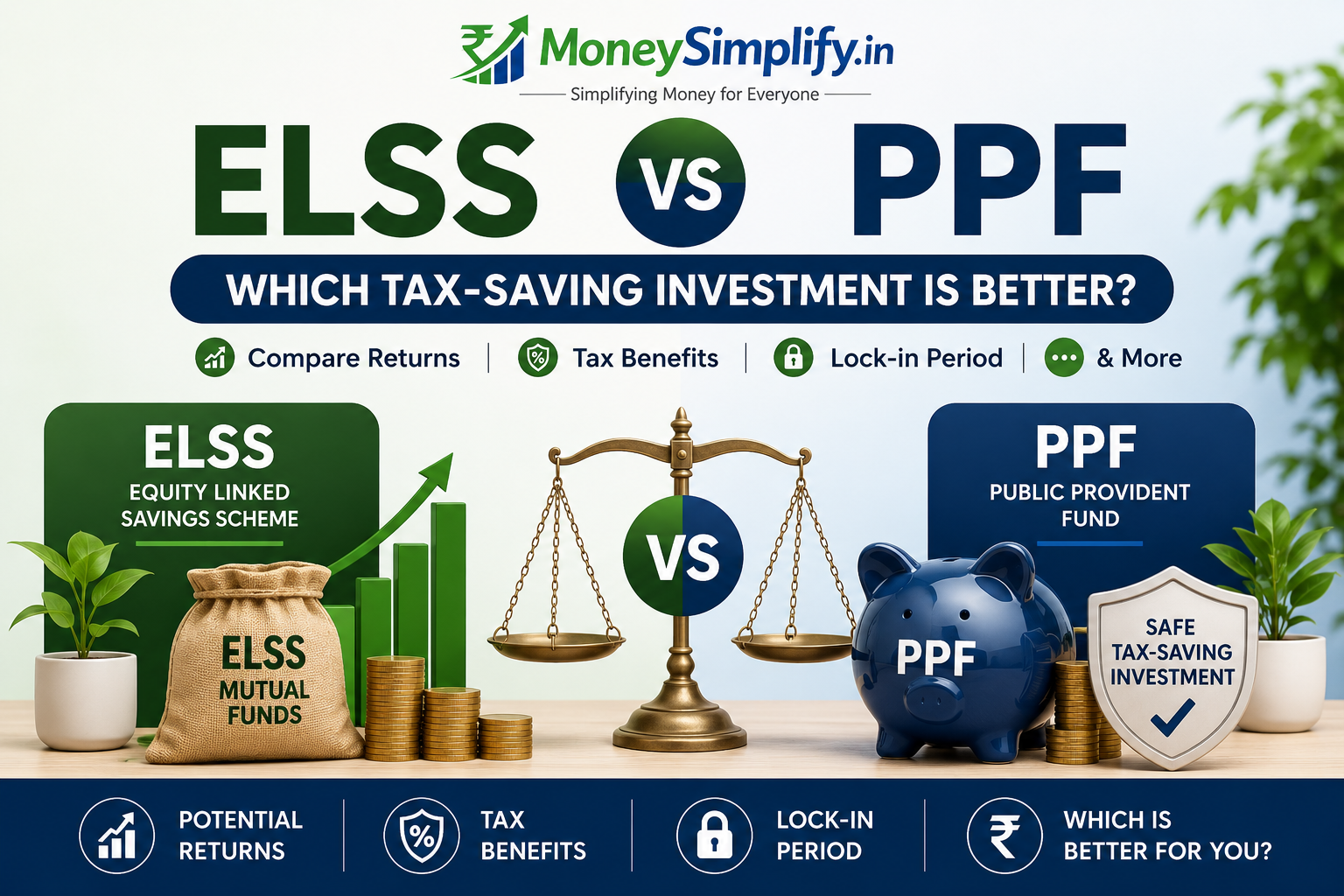

If you’re looking for a way to save taxes while also building long-term wealth, you’ve probably come across ELSS funds.
ELSS, or Equity Linked Savings Scheme, is one of the most popular tax-saving investment options available in India. It combines the benefits of:
- Tax savings under Section 80C
- Equity market exposure
- Potential long-term wealth creation
Unlike many traditional tax-saving investments, ELSS funds invest primarily in stocks, offering investors the opportunity to earn market-linked returns.
But how do ELSS funds work? Are they suitable for beginners? And how do they compare with other tax-saving investments?
In this guide, we’ll explain everything you need to know about ELSS funds in simple terms.
What Is ELSS?
ELSS stands for Equity Linked Savings Scheme.
It is a type of mutual fund that invests a significant portion of its portfolio in equity and equity-related securities.
The main attraction of ELSS funds is that they qualify for tax deductions under Section 80C of the Income Tax Act.
This means investors can claim deductions of up to:
₹1.5 lakh per financial yearby investing in eligible ELSS schemes.
How Do ELSS Funds Work?
ELSS funds pool money from multiple investors and invest it in a diversified portfolio of stocks.
Professional fund managers manage these investments and make decisions regarding:
- Stock selection
- Sector allocation
- Portfolio rebalancing
- Risk management
Since ELSS funds invest in equities:
Returns are market-linked and not guaranteed.
However, equities have historically offered the potential for higher long-term returns compared to many traditional savings instruments.
Why Are ELSS Funds Popular?
ELSS funds are popular because they offer a combination of:
Tax Benefits
Investments qualify for deductions under Section 80C.
Wealth Creation Potential
The equity component allows investors to participate in long-term market growth.
Professional Management
Experienced fund managers manage the portfolio.
Diversification
Funds invest across multiple companies and sectors.
Short Lock-In Period
ELSS has the shortest lock-in period among major Section 80C investments.
Tax Benefits of ELSS Funds
One of the biggest advantages of ELSS is tax saving.
Under Section 80C:
Maximum deduction: ₹1.5 lakh per financial yearIf an investor falls within a taxable income bracket, ELSS investments may help reduce taxable income according to prevailing tax regulations.
However, investors should always review the latest tax rules before making investment decisions.
ELSS Lock-In Period
Every ELSS investment comes with a mandatory lock-in period of:
3 YearsThis means investors cannot redeem their units before the completion of three years from the investment date.
The lock-in period encourages long-term investing and helps investors avoid making emotional decisions during short-term market fluctuations.
ELSS vs Other Section 80C Investments
Many investors compare ELSS with traditional tax-saving options.
| Investment | Lock-In Period | Risk Level | Return Type |
|---|---|---|---|
| ELSS | 3 Years | Moderate to High | Market-Linked |
| PPF | 15 Years | Low | Government-Declared |
| Tax-Saving FD | 5 Years | Low | Fixed Interest |
| NPS | Long-Term | Moderate | Market-Linked |
ELSS stands out because of its relatively short lock-in period and growth potential.
Can You Invest in ELSS Through SIP?
Yes.
Investors can invest in ELSS through:
Lump Sum Investment
A one-time investment amount.
SIP (Systematic Investment Plan)
Regular monthly investments.
SIP investing allows investors to:
- Invest consistently
- Manage market volatility through rupee cost averaging
- Build disciplined investment habits
Many beginners prefer SIPs because they allow investing with smaller amounts while maintaining consistency.
Who Should Consider ELSS Funds?
ELSS may be suitable for investors who:
✓ Want to save taxes under Section 80C.
✓ Have a long-term investment horizon.
✓ Are comfortable with market-linked investments.
✓ Seek wealth creation opportunities.
✓ Prefer a shorter lock-in period compared to PPF and tax-saving FDs.
However, investors should ensure that ELSS aligns with their financial goals and risk tolerance.
Risks of ELSS Funds
Like all equity investments, ELSS funds carry risks.
These include:
Market Risk
Stock market fluctuations can impact fund performance.
Volatility
Short-term ups and downs are normal.
No Guaranteed Returns
Returns depend on market performance and fund management.
Investors should avoid investing solely based on past returns.
Instead, they should focus on long-term objectives and portfolio suitability.
In the next section, we’ll discuss how to choose the right ELSS fund, common mistakes to avoid, ELSS taxation, FAQs, and whether ELSS is a good investment for beginners.
How to Choose the Right ELSS Fund
Not all ELSS funds perform the same way. Before investing, consider the following factors:
1. Fund Performance
Review the fund’s performance over different market cycles.
Avoid choosing a fund solely based on recent returns.
Instead, evaluate:
- Consistency of performance
- Performance against benchmark indices
- Performance relative to peers
2. Fund Manager Experience
The experience and track record of the fund manager can influence portfolio decisions and overall fund performance.
3. Investment Strategy
Different ELSS funds may follow different approaches, such as:
- Large-cap focused investing
- Mid-cap and small-cap exposure
- Diversified equity investing
Investors should choose a strategy that aligns with their risk tolerance.
4. Expense Ratio
The expense ratio represents the annual fee charged by the fund house for managing the scheme.
A lower expense ratio can help investors retain a larger share of returns over the long term.
5. Risk Profile
Every investor has a different risk appetite.
Choose an ELSS fund that matches your:
- Financial goals
- Investment horizon
- Comfort with market volatility
Taxation of ELSS Funds
Many investors assume ELSS is completely tax-free. However, understanding taxation is important.
At the Time of Investment
Investments qualify for deductions under:
Section 80C
up to the applicable limit prescribed by tax laws.
During the Investment Period
There is generally no tax liability while the investment remains invested.
At Redemption
Since ELSS invests in equities, taxation is governed by applicable equity mutual fund taxation rules.
Tax regulations may change over time, so investors should always verify current tax provisions before redemption.
Advantages of ELSS Funds
Tax Saving
ELSS provides deductions under Section 80C.
Wealth Creation Potential
Equity exposure offers the possibility of long-term capital appreciation.
Short Lock-In Period
At:
3 years
ELSS has the shortest lock-in period among major Section 80C investment options.
Professional Management
Investments are managed by experienced fund managers.
SIP Option Available
Investors can start with relatively small monthly SIP amounts.
Disadvantages of ELSS Funds
Market Risk
Returns are not guaranteed.
Volatility
Portfolio value may fluctuate significantly in the short term.
Mandatory Lock-In
Investors cannot redeem units before completing the lock-in period.
Tax Rules May Change
Future tax treatment depends on prevailing regulations.
Common Mistakes to Avoid
Many beginners make avoidable mistakes while investing in ELSS.
Investing Only for Tax Saving
Tax saving should not be the only reason for investing.
Always consider your overall financial goals.
Chasing Past Returns
A fund that performed well recently may not necessarily outperform in the future.
Ignoring Risk Tolerance
ELSS invests in equities and may not suit every investor.
Redeeming Immediately After Lock-In
Many investors withdraw as soon as the three-year lock-in ends.
Longer holding periods may help investors benefit from the power of compounding and market growth.
Investing Without Understanding the Fund
Always read scheme information and understand investment objectives before investing.
ELSS vs Tax-Saving FD
Many investors compare ELSS with tax-saving fixed deposits.
| Feature | ELSS | Tax-Saving FD |
|---|---|---|
| Tax Benefit | Yes | Yes |
| Lock-In Period | 3 Years | 5 Years |
| Risk Level | Moderate to High | Low |
| Return Type | Market-Linked | Fixed |
| Wealth Creation Potential | Higher Potential | Limited |
| Capital Protection | No Guarantee | Generally Available |
Investors seeking growth may prefer ELSS, while conservative investors may prefer tax-saving FDs.
Frequently Asked Questions (FAQs)
What does ELSS stand for?
ELSS stands for:
Equity Linked Savings Scheme
It is a tax-saving mutual fund eligible for Section 80C deductions.
Is ELSS better than PPF?
Neither investment is universally better.
ELSS may suit investors seeking growth, while PPF may suit investors prioritizing safety and stability.
Can I invest in ELSS through SIP?
Yes.
Most fund houses allow investors to invest in ELSS through SIPs.
What is the lock-in period of ELSS?
The lock-in period is:
3 years
from the date of each investment.
Are ELSS returns guaranteed?
No.
ELSS returns are market-linked and depend on the performance of the underlying investments.
Can beginners invest in ELSS?
Yes.
ELSS can be suitable for beginners who:
- Have a long-term investment horizon,
- Understand market risks,
- Want tax-saving benefits.
Final Verdict
ELSS funds are one of the most popular tax-saving investment options available in India.
They offer:
✓ Section 80C tax benefits.
✓ Equity market participation.
✓ Long-term wealth creation potential.
✓ Professional management.
✓ The shortest lock-in period among major tax-saving investments.
However, investors should remember that ELSS is an equity-based investment and therefore carries market risk.
Before investing, assess your:
- Financial goals,
- Risk tolerance,
- Investment horizon,
- Overall portfolio allocation.
Conclusion
ELSS funds provide a unique combination of tax savings and long-term wealth creation opportunities.
For investors who are comfortable with market fluctuations and are looking to build wealth while reducing taxable income, ELSS can be a valuable addition to a diversified investment portfolio.
As with any investment decision, thorough research and proper financial planning are essential before investing.
Disclaimer: This article is intended for educational purposes only and should not be considered financial, investment, or tax advice. Tax laws and investment regulations may change over time. Please consult a qualified financial advisor or tax professional before making investment decisions.